

The question, and the short answer
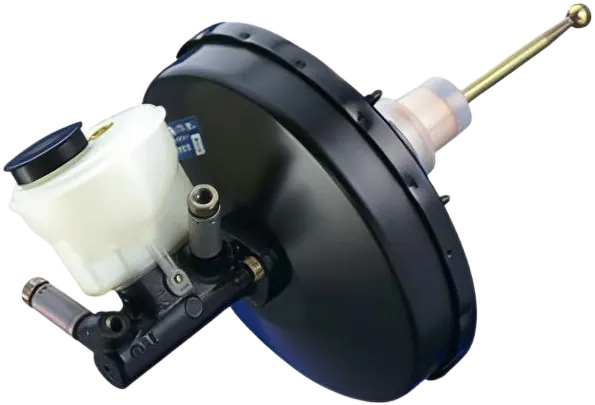
A vacuum brake booster needs a pressure difference to work, and for most of a century that difference came free: a petrol engine’s intake manifold is a vacuum source that runs whenever the engine does. Electrification removes the gift. A battery-electric vehicle has no manifold; a hybrid’s engine stops whenever it can; even a modern downsized petrol engine under boost is, at that moment, a pressure source rather than a vacuum source. So the buyer question behind a growing share of booster and vacuum pump enquiries is a real one: when the engine can no longer be relied on, how should brake assist be supplied — and what should a buyer check in each route? The literature offers two answers. The conservative one keeps the vacuum booster and gives it a dedicated electric vacuum pump that runs on demand. The radical one deletes the vacuum entirely and replaces the booster with an electromechanical unit that pushes the master cylinder with a motor. Read together, the studies say the vacuum route’s weakness is not the quality of its assist — on the bench, an electric pump holds vacuum steadier than an engine does — but the control of the pump: its switching thresholds, its thermal life, and its behaviour at altitude. The electromechanical route’s advantage is equally specific: it is not stronger assist, but assist that can be decoupled from the pedal and blended with regenerative braking. The two routes solve different problems, and they are not interchangeable line items.
What the bench evidence says: an electric pump is steadier than an engine
The most direct comparison comes from Berjoza and co-authors at the Latvia University of Agriculture (Engineering for Rural Development, 2016), who ran three vehicles through the same braking cycle on a roller test bench: a petrol Renault Clio drawing booster vacuum from its intake manifold, a diesel Renault Trafic with an engine-driven vacuum pump, and a converted electric Clio fitted with an electric vacuum pump. The petrol car’s manifold produced the deepest vacuum of the test, −0.82 bar while accelerating — and then gave much of it back exactly when it was needed, falling to −0.60 bar after a single brake application and −0.53 bar under repeated applications, average falls of 26.8% and 36.4% in the braking regimes. The diesel’s engine-driven pump showed the opposite pattern and a wider swing: vacuum sagged to −0.41 bar under acceleration, because the turbocharger’s control valve was drawing on the same vacuum line, and recovered to −0.77 bar when braking near idle. The electric car’s pump did neither. It held an average of −0.63 bar across the cycle, and its worst fall — again under repeated pedal applications — was 15.8%, to the same −0.53 bar floor the petrol car reached. The authors’ conclusion was plain: the electric pump gave the steadiest vacuum of the three systems and was fully sufficient in capacity and level for the vehicle.
Two things follow for buyers. First, “electric pump vacuum is weaker” is not what the evidence shows; the pump’s peak (−0.63 bar average) sits below the manifold’s best (−0.82 bar) but far above the manifold’s worst, and assist quality in service is set by the worst case, not the best. Second, every supply source in the test — manifold, engine pump, electric pump — converged to roughly the same floor under repeated applications. Repeated-application reserve is a property of the booster-and-reservoir volume as much as of the source, which is why it belongs in a specification conversation and not just in a pump datasheet.
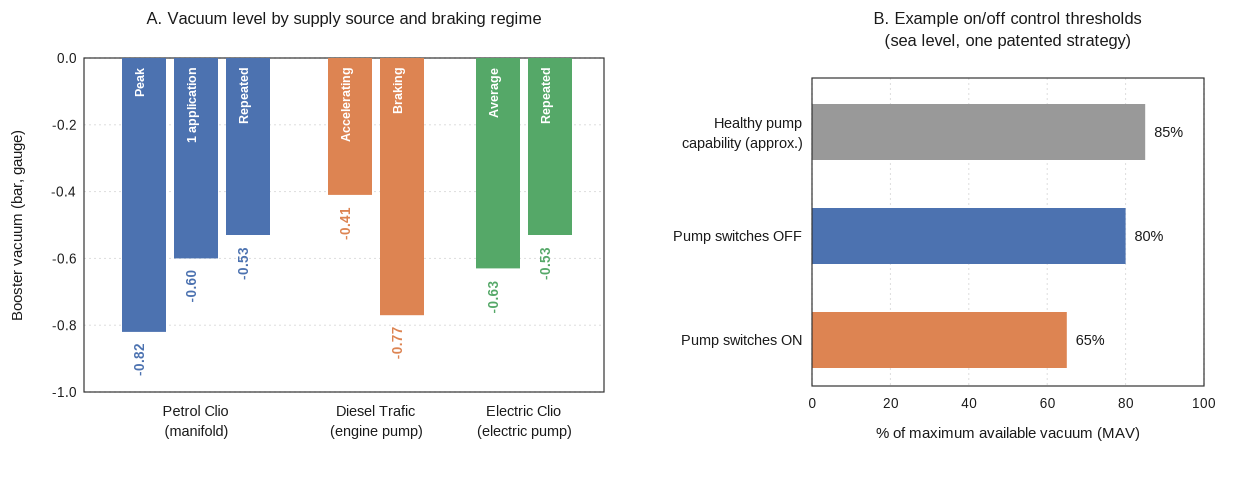
Figure 1. (A) Booster vacuum recorded on a roller test bench for three vacuum supply sources under a common braking cycle (Berjoza et al., 2016). (B) Example electric-pump switching thresholds expressed as percentages of maximum available vacuum, from one patented control strategy at sea level (US20150037172A1). The two panels come from different sources and are not directly comparable.
The vacuum route’s real problem is control: thresholds, altitude and pump life
If the pump can supply the vacuum, the research frontier moves to how it is switched. An engine-driven pump runs continuously at engine speed and is oil-cooled; an electric pump in an EV has, as Dake and co-authors at Tata Motors note (SAE Technical Paper 2021-26-0139, 2021), no comparable cooling provision, so it must run only when needed — which makes its operating strategy a durability decision, not just an energy one. Their work built a machine-learning model, validated against field test data, to estimate the optimum threshold operating range for an EV vacuum pump and to predict pump life from it. The threshold range is the product, in a sense: set the band too tight and the pump short-cycles itself to death; too loose and the booster reserve is allowed to decay toward the hard-pedal condition the failed-assist regulations assume the driver can still handle.
A patented control method (US20150037172A1) shows what those thresholds look like in practice and where fixed values break. In the strategy it describes, switching points are set as percentages of the maximum available vacuum (MAV): the pump switches on at 65% of MAV (−65.6 kPa at sea level) and off at 80% (−80.8 kPa), against a healthy-pump capability of roughly 85% of MAV. The document’s central observation is about altitude. At elevation, atmospheric pressure — and therefore the maximum vacuum any pump can reach — falls. A fixed switch-off point chosen for sea level can sit at or above what the pump can achieve in the mountains, so a pump commanded by fixed thresholds may simply never switch off: continuous running, heat, and accelerated wear, in exactly the thin-air conditions where assist margin is already smallest. The patented answer is to reference both thresholds to measured ambient pressure. Whether or not a given pump implements that specific method, the underlying physics is not optional, and it converts directly into a buying question for any distributor serving high-altitude markets: are this pump’s thresholds fixed, or are they compensated — and what is the pump’s rated ultimate vacuum as a percentage of what sea-level air allows?
The alternative deletes the vacuum: electromechanical boosters
The second route removes the question instead of answering it. An electromechanical booster — the E-Booster in the research literature, sold under names such as iBooster in production — replaces the diaphragm and vacuum supply with an electric motor and gear train that drive the master cylinder piston directly, with the pedal feel synthesised rather than transmitted. Mei and co-authors (Frontiers in Robotics and AI, 2023) explain why vehicle makers accept that complexity: with an E-Booster, pedal feel and wheel-cylinder pressure are decoupled, so the friction brakes can be blended with the traction motor’s regenerative braking — holding back hydraulic pressure while the motor does the slowing — without the pedal moving under the driver’s foot. Their contribution is a control result: a switchable model-predictive controller that, in simulation, cut the system’s control latency by 85 milliseconds and improved control accuracy by 22.6% relative to a single-controller design, while keeping pedal feel consistent across regenerative and non-regenerative braking. Chinese OEM research reaches the same destination from the vehicle side. Zhang and co-authors at the Geely Automobile Research Institute (Huanjing Jishu / Environmental Technology, 2022), comparing the two assist types on EV braking performance, note that the vacuum route obliges an EV to carry an added vacuum pump and storage unit, while electronic assist integrates more highly with fewer parts, coordinates regenerative braking at higher decelerations, and thereby extends range — and that EVs have consequently adopted electronic assist as the mainstream solution.
Notice what neither source claims: that electromechanical assist stops the car shorter in a friction-only stop, or that it is cheaper, or that it retrofits. Its documented advantages are architectural — blending, decoupling, integration — and they accrue to the vehicle designer who specifies the whole brake system, not to a parts buyer choosing between two boosters for an existing vehicle.
Our assessment
Three conclusions follow, in our view, when these sources are read together.
First, the vacuum booster is not being killed by electrification; its vacuum supply is being professionalised. The bench evidence says a demand-controlled electric pump already supplies vacuum more consistently than the manifold it replaces. What the EV application changes is the engineering centre of gravity: from the booster, whose physics is settled, to the pump’s control strategy and rated life, which is where the current research — threshold optimisation, altitude compensation, life prediction — is concentrated. Buyers should allocate their scrutiny accordingly.
Second, electromechanical boosters and vacuum boosters are answers to different questions, and treating them as substitutes is a category error. The E-Booster’s value is realised in a vehicle designed around regenerative blending; it is an integrated, vehicle-specific, software-bearing unit. The vacuum booster plus electric pump is a serviceable, cross-referenced, mechanically understood system that fits the parc that actually exists — hybrids whose engines stop, turbocharged and diesel vehicles whose vacuum is conditional, and cost-sensitive EVs that keep the vacuum architecture. That parc will need boosters and pumps for its whole service life regardless of what new platforms adopt.
Third, the most under-asked question in vacuum pump sourcing is not peak vacuum. Every supply source in the bench test reached an adequate level; they differed in how far they fell under repeated applications and in how the supply behaved across regimes. For pumps, the specification questions that predict field behaviour are the switching thresholds and whether they are altitude-compensated, the rated duty and life evidence behind them, and the pump’s behaviour when it cannot reach switch-off. A pump quoted on ultimate vacuum alone is being quoted on the one number the research says matters least.
What to ask when specifying
For distributors, workshops and remanufacturers, the checklist divides by route. For a vacuum booster, the established discipline stands: match the OE number and the construction — single or tandem diaphragm — and the mechanical interfaces, because failed-assist performance is regulated at vehicle level and a look-alike shell is not a substitute. For an electric vacuum pump feeding that booster, add the control questions: the switch-on and switch-off thresholds (and their units — absolute pressure, gauge vacuum, or percentage of maximum available vacuum), whether they are compensated for altitude, the pump’s ultimate vacuum and its recovery after repeated brake applications, and the rated life or duty evidence, remembering that an EV installation gives the pump no oil cooling and no continuous-running design assumption. For an electromechanical booster, recognise that you are no longer cross-referencing a pneumatic part: fitment is vehicle- and software-specific, and the honest questions are about the exact application, not about ratios or sizes. In all three cases, the enquiry that gets a useful answer states the vehicle, the OE number, and the operating environment — including altitude, if the vehicles will work in the mountains.
Limits of the evidence
The boundaries are real. Berjoza et al.’s bench comparison is one small converted EV and two combustion cars of its era, on one laboratory cycle; its values describe those vehicles, not every pump or manifold. Dake et al.’s threshold-and-life work was verified here at abstract level — the direction of its findings is clear, but its specific optimum thresholds sit in the full text and are not quoted. The switching percentages in US20150037172A1 are one applicant’s example values inside a patent document, not an industry standard, and other makers set their bands differently. Mei et al.’s latency and accuracy figures are simulation results for a controller, not measurements of a production booster. Zhang et al. was verified through its bibliographic record and a translated abstract rather than the full Chinese text, so only its qualitative conclusions are used here. And no source reviewed measures the long-term field durability of electric pumps against electromechanical boosters in comparable fleets — the comparison the aftermarket most wants is the one the literature has not yet run.
Specifying with the evidence in hand
None of this changes what a booster is for; it changes which questions decide whether the part in the box is the right one. The FIVER catalogue covers vacuum brake boosters and brake vacuum pumps across a wide range of OE applications, and the most useful enquiry a buyer can send states the vehicle and OE number, whether the application is a conventional, hybrid or electric platform, and the conditions the vehicles work in. Those details are what separate a booster that merely bolts on from an assist system that still feels right at the tenth application, at altitude, at the end of the pump’s design life.
Sources
- Berjoza, D., Pirs, V., & Dukulis, I. (2016). “Experimental investigation of effectiveness of electric vehicle vacuum brake booster on power test bench.” Engineering for Rural Development, Jelgava, 25–27 May 2016, pp. 1193–1198. https://doczz.net/doc/8595785/experimental-investigation-of-effectiveness-of
- Dake, P., Mohan, S., & Mullapudi, D. (2021). “Machine Learning based Operation Strategy for EV Vacuum Pump.” SAE Technical Paper 2021-26-0139. https://doi.org/10.4271/2021-26-0139
- US Patent Application US20150037172A1 (2015). “Method of controlling vacuum pump for vehicle brake booster.” https://patents.google.com/patent/US20150037172A1
- Mei, M., Cheng, S., Mu, H., Pei, Y., & Li, B. (2023). “Switchable MPC-based multi-objective regenerative brake control via flow regulation for electric vehicles.” Frontiers in Robotics and AI, 10, 1078253. https://doi.org/10.3389/frobt.2023.1078253
- Zhang, S., Ao, Y., Du, J., Gao, W., & Fan, W. (2022). “Electric vehicle brake performance study based on electric booster” [in Chinese]. Huanjing Jishu (Environmental Technology), 40(3), 173–178.
Need this part for your channel?
Send the OE number and the quantity you need, and we will confirm the listing and reply with a quotation.